 Skip to content




Moleskine vs Leuchtturm1917: Which Notebook Should You Choose for Work and Journaling?
Two black notebooks can look remarkably similar when they are closed. Open them, start writing and the differences become more personal. One might offer the organisation you want for project notes. Another might have the shape and simplicity that make you carry it everywhere.
Moleskine and Leuchtturm1917 are frequently compared because both occupy that useful space between everyday stationery and a notebook you deliberately choose. But a fair comparison needs more than two brand names. Size, paper edition, ruling and cover construction can vary within each range.
At Makoba, we would choose by how you intend to fill the pages. This guide uses classic notebook formats as the starting point, explains the details worth checking and separates practical buying advice from broad claims about which brand is better.
Key highlights
- Compare exact notebook editions rather than entire brands.
- Moleskine Large and a standard A5 format are not necessarily the same dimensions.
- Numbering, an index and bookmarks matter if you need to retrieve notes later.
- Fountain pen suitability depends on the specific paper, nib and ink.
- Pick the notebook you will carry and use, not only the cover you prefer.
Start with the job the notebook must do
Are you recording meetings, keeping a personal journal, managing tasks or sketching ideas? Each purpose changes the features that deserve attention. A meeting notebook needs easy retrieval. A personal journal may need comfortable long-form pages. A portable ideas book needs to fit your bag.
Think about what happens after a page is written. If you need to find information weeks later, navigation features become useful. If you write continuously and rarely search backwards, a simpler structure may be entirely sufficient.
There is no need to make a notebook serve every possible purpose. One well-defined role can make the choice easier and the finished book more useful.
What we are comparing
The relevant starting point is the classic everyday notebook, not a planner, sketchbook or specialist paper edition. Moleskine and Leuchtturm1917 both offer other products whose characteristics should not be inferred from a general comparison.
Our Moleskine Ruled Notebook listing and Leuchtturm1917 Classic Black A5 Ruled listing provide catalogue references. Check the precise specifications of the item you intend to buy.
This is a buying guide, not a claim that we have run a controlled writing test on every current notebook batch. Where your pen-and-ink combination is demanding, test the exact paper rather than treating a brand recommendation as a guarantee.

Size: similar names can hide different proportions
Moleskine's familiar Large Classic format is commonly specified as 13 by 21 centimetres. Leuchtturm1917's Medium A5 Classic format is wider, commonly specified as 14.5 by 21 centimetres. Check the exact product, because the names are not a promise of identical dimensions.
That difference affects how the page feels. More width can help with meeting columns, wider handwriting or diagrams. A narrower book may fit a particular pocket or bag compartment more conveniently.
Do not decide from the word A5 alone when a listing uses a familiar size category. Compare the actual dimensions. A notebook that fits your existing cover or organiser needs a physical match, not just a similar label.
How much writing space do you need?
Write a few normal lines on a sheet cut to each width if you cannot compare the books physically. Notice whether headings and lists feel cramped. Think about the margins you naturally leave rather than assuming you will write edge to edge.
For work, consider whether the page needs room for a date, action points and a small diagram. For journaling, consider whether the width encourages the paragraph length you enjoy. The useful page is the one that fits your habits.
Organisation: where Leuchtturm's structure can help
The classic Leuchtturm format is known for navigation features such as numbered pages and a contents section, alongside bookmarks and a pocket. Our listed A5 ruled model identifies these features in its product details.
They can be helpful when the notebook holds several projects. Record a topic in the contents and add its page numbers as it develops. You can then use the next available page rather than guessing how many pages each project will need.
This structure is valuable only if you use it. If an index becomes another task you resent maintaining, it may contribute little to your routine. Features should solve an actual retrieval problem.
When a simpler notebook is enough
If you use a notebook chronologically, dates may provide all the organisation you need. A personal journal, daily observations or a running ideas book does not always require numbered pages.
A simpler format can also feel less prescriptive. You can create your own index, add page numbers as needed or leave the book entirely informal. The absence of a feature is not automatically a disadvantage if you would not use it.
Choose between ready-made structure and the structure you are happy to create. The right answer depends on the role of the notebook, not the number of features on a comparison chart.
Paper: the most important comparison for fountain pen users
Paper affects line width, edge definition, drying time and visibility through the page. These properties depend on more than thickness. Surface treatment and absorption matter, as do the nib and ink.
Classic Moleskine and Leuchtturm ranges have published paper specifications, but editions and formats can differ. Do not transfer a result from one specialised version to the whole brand. A sketchbook, thicker-paper edition or different notebook size may behave differently.
For a fountain pen buyer, we would give particular attention to the exact Leuchtturm paper specification and test it against the intended use. That is a starting direction, not a promise of zero feathering or bleed with every ink.
Avoid the universal fountain pen test
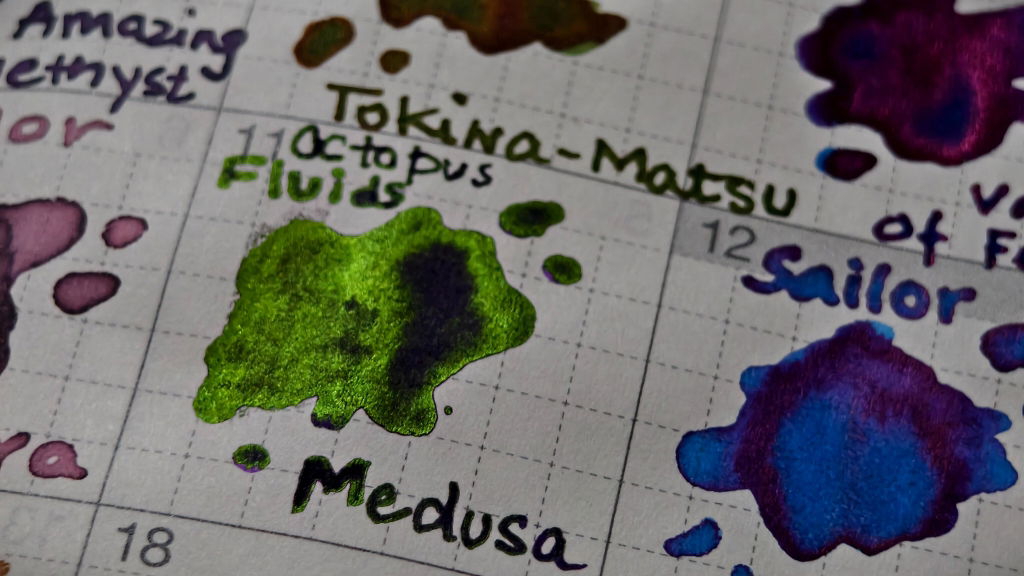
A wet broad nib and a fine everyday nib deposit different amounts of ink. An ink chosen for strong visual effects can behave differently from a conventional blue. A single dramatic swatch therefore cannot settle every user's question.
Write normal text with the pen you intend to use. Inspect both sides after drying. Look at the line edges and assess whether your usual writing remains clear. That test gives a more relevant result than a brand reputation alone.
Our paper science guide explains what to look for. A notebook comparison becomes more useful when the terms describe actual observations.
Ghosting and bleed-through are different
Ghosting is seeing the writing through the sheet without ink physically passing to the other side. Bleed-through means ink has penetrated through. The distinction matters because users tolerate them differently.
Someone writing on both sides may find visible ghosting distracting even when the paper has not bled. Another person may accept it in exchange for a lighter, slimmer book. Neither response is wrong.
Inspect the page under ordinary lighting rather than holding it against a window. The test should reflect how you will use the notebook. Decide whether the result is comfortable for you instead of chasing a universal verdict.
Drying time can change the preferred notebook
A paper that leaves ink near the surface can preserve attractive colour and sharper edges. It can also require more time before you turn the page or move a hand across the line. Absorbency changes that balance.
For left-handed writers, rapid note-taking or tightly packed meeting pages, practical drying deserves attention. A notebook praised for expressive ink effects may not be the one you prefer during a busy day.
Our left-handed writing guide explains the interaction between hand movement, ink and paper. The notebook is part of that setup, not an unrelated accessory.
Ruling: choose for the content
Ruled pages are useful for continuous prose and conventional notes. Dotted pages provide quieter alignment for lists, tables and flexible layouts. Squared pages may suit calculations or structured diagrams, while plain pages give more freedom for sketches.
Both brands offer different layouts in their wider ranges. Verify the actual variant before ordering; a cover photograph may look identical across several rulings. Line spacing and dot spacing can also affect how comfortably your handwriting fits.
If you are starting a bullet journal, dotted is a convenient option rather than a requirement. Our simple bullet journal guide explains how to begin without making elaborate artwork a condition of using the notebook.
Hard cover or soft cover?
A hard cover provides support and protection, especially when the notebook travels in a bag. A soft cover may feel lighter and more flexible. The best choice depends on where you write and what you carry.
If you write only at a desk, support may matter less than how comfortably the book opens. If you jot notes while standing or away from a table, a firmer cover can be helpful.
Compare the exact construction rather than assuming a brand offers only one type. Page counts and dimensions can vary between hard and soft versions, changing the whole object rather than just the surface material.
Binding and the middle of the book
A notebook can look attractive closed and feel awkward near the binding. Open it at the beginning, middle and end if possible. Notice whether the pages stay comfortably accessible without being forced flat.
For long writing, your hand needs a stable surface across the page. For diagrams, the central fold can interrupt a continuous drawing. These are different requirements, and neither is fully described by a cover photograph.
Do not force a new binding beyond its intended movement. Follow the maker's construction and handling guidance. Comfortable opening is a useful buying consideration, not a reason to stress the spine during a demonstration.
Which is better for work notes?
Leuchtturm's ready-made navigation can be useful for a notebook containing several meetings and projects. Page numbers and a contents section make it easier to refer back to a decision or continue a topic later.
Moleskine can appeal when you prefer a straightforward chronological book and its proportions fit your carrying routine. Add dates and clear headings, and a simple notebook can still be highly usable.
The deciding question is retrieval. Do you frequently search for an old action point, or mostly use the most recent pages? Choose features around that behaviour rather than assuming the more organised-looking product will organise your work automatically.
Which is better for personal journaling?
For continuous personal writing, choose the page you want to return to. Paper colour, ruling, width and the feel under your hand can matter more than an index. If you enjoy fountain pens, test the preferred ink combination.
Some journal writers like a narrower book because it makes a daily page feel approachable. Others want wider pages for longer paragraphs. Neither approach predicts the quality of the writing; it simply affects the invitation to begin.
Use the notebook for an ordinary entry before judging its suitability. A book that feels perfect in a product photograph may be less natural when your hand reaches the inner margin.
Which is better for bullet journaling?
A numbered book with a contents section can reduce setup work, making Leuchtturm a useful starting direction. Dotted ruling can help align columns and headings without a full grid.
However, the method can work in a simple notebook. You can number pages yourself and use basic lists. Choosing Moleskine does not prevent a practical bullet journal, and choosing Leuchtturm does not require elaborate layouts.
Start with the amount of structure you will maintain. If decorative spreads delay writing the tasks themselves, simplify the system. The notebook should make it easier to use the method, not become an entrance examination for it.
Compare the complete object
| Your priority | What to check |
|---|---|
| Portable daily notes | Actual width, thickness and bag fit |
| Retrieving old information | Numbering, contents and bookmark arrangement |
| Fountain pen writing | Exact paper edition and your pen-and-ink result |
| Long journal entries | Ruling, opening comfort and page width |
| Planning and lists | Layout flexibility and usable writing space |
| Gifting | Recipient's writing format and preferred notebook size |
Use the table to narrow the decision, then inspect the product details. A longer feature list is useful only when the features solve your own requirements.
Price: think about use, not cost per page alone
Cost per page can be informative, but it does not tell you whether the notebook will be carried or whether both sides are comfortable to use. A larger book may offer more pages while being less convenient for your day.
Check current prices for the actual edition and ruling. Page count, cover type and special ranges can change the comparison. Avoid treating an old review's price as a current Indian quotation.
The notebook you finish is often better value than the one whose specifications impressed you but whose proportions never suited your bag or desk.
Pair the notebook with the pen you already enjoy
There is no need to buy a new pen to make a notebook purchase meaningful. Start with your familiar instrument and observe the result. That gives you a clearer comparison because you know how the pen normally behaves.
If you are building a first fountain pen setup, choose the two together. Our starter setup guide explains how nib, ink and paper interact.
For a wider paper shortlist, browse our notebook collection. The right answer may be one of these two brands, or a different paper that better serves the writing experience you want.

A useful comparison page to make yourself
Use the same pens and write the same short passage in each notebook. Add the date and exact product name. Include normal handwriting, a small heading and a few numbers; avoid relying solely on heavy swatches.
After drying, inspect line edges, the reverse side and surface smudging. Note how comfortable the page feels near the binding. Then consider the experience of carrying and reopening the notebook during a normal day.
Keep the result honest. If you have tested only one colour and nib, describe that combination rather than declaring a winner for all fountain pens. Practical evidence becomes more useful when its limits are clear.
Buying as a gift
Find out whether the recipient uses a fountain pen, ballpoint, gel pen or pencil. Ask about preferred size and whether they write paragraphs or plan with lists. Those details can matter more than choosing the brand you personally recognise first.
A pen-and-notebook combination can be thoughtful when the items work together. Avoid adding a wet fountain pen simply because the notebook looks premium; the paper and intended use need to support it.
If you are unsure, tell us the recipient's routine. At Makoba, we can help compare the exact products and the writing formats they are most likely to enjoy.
Three everyday notebook choices
A project manager who needs to find decisions
Suppose the book contains notes from several clients or workstreams. Ready-made page numbers and an index can help connect related entries without dividing the notebook into fixed blocks. In that case, the Leuchtturm Classic's navigation deserves real weight in the decision.
However, the habit of entering useful references still matters. A numbered page that never reaches the index is only a number. Choose the feature because you will use it during a weekly review or before the next meeting, not because it makes the product description longer.
A commuter who writes short observations
Suppose the notebook is opened briefly during the day and carried constantly. Dimensions, thickness and cover flexibility may matter more than retrieval features. A familiar Moleskine format may fit that routine well if the exact paper suits the chosen pen.
Measure the available space in the bag or cover rather than assuming two similar-looking books will fit identically. The best portable notebook is the one you bring with you consistently, not the one with the most room left unused at home.
A fountain pen journal writer
Suppose the main pleasure is writing several pages with a favourite ink. Begin with paper behaviour, opening comfort and line spacing. Test ordinary text with the intended nib, then look at both sides after drying. The brand name is less informative than the result of that actual combination.
If you cannot test, ask about the exact edition and avoid extreme claims. A conventional ink and an appropriate nib provide a more manageable starting point than assuming a premium cover guarantees compatibility with every wet or decorative formula.
Keep your buying priorities in order
Choose the purpose, then the size, then the paper and navigation needs. Finish with cover colour and presentation. This order does not make appearance unimportant; it simply makes sure the attractive object is also a useful one.
If two options meet the practical requirements equally, choose the one you enjoy opening. A notebook is an intimate everyday object, and preference is a reasonable final decision. You do not need a universal winner to make a confident purchase.
When the first book is finished, note what you would keep and change. Perhaps the index was valuable, the size was ideal or the ruling felt cramped. That experience is a stronger guide to the next notebook than beginning the comparison again from brand reputation alone.
Our verdict
Choose Leuchtturm1917 when ready-made navigation and a structured classic notebook are priorities. Give its exact paper edition careful consideration if fountain pen writing is central to the purchase.
Choose Moleskine when its format, simplicity and carrying experience are the features you value. Check the specific edition and test liquid-ink behaviour rather than assuming every product shares the same paper performance.
The best notebook is the one whose pages fit your work and whose physical form makes you bring it along. Open it, picture the content you will put there and choose around that real use.
Frequently asked questions
Are Moleskine Large and A5 identical sizes?
Not necessarily. Compare the listed dimensions. Familiar Large Classic and Medium A5 formats can differ in width despite looking similar online.
Is one brand guaranteed not to bleed?
No universal claim is useful across all editions, inks and nibs. Test the specific notebook with the writing combination you intend to use.
Do I need dotted paper for a bullet journal?
No. Dotted ruling is convenient for flexible layouts, but a practical system can be built in ruled, squared or plain notebooks too.
Which should I choose if I cannot test them?
Start with the exact specifications, your writing format and your need for navigation. Ask us about the listed edition rather than relying on a general brand reputation.


Leave a comment