 Skip to content




Can Left-Handed Writers Use Fountain Pens? A Guide to Comfortable, Smudge-Free Writing
If you write with your left hand, you may have learned to judge a pen by the side of your palm. A page can look perfectly neat until your hand moves across the last line. Add the idea of a wet fountain pen nib and it is easy to assume the whole category will be inconvenient.
It does not have to be. Left-handed writers use fountain pens successfully, but a recommendation based only on the word left-handed misses the important details. Where your hand travels, how the pen rotates and how quickly the ink dries matter more than a single label.
At Makoba, we would start by watching a few lines of your normal handwriting. The aim is to find a comfortable pen, nib, ink and paper combination around your existing habits. This guide explains what to observe and how to make useful changes without forcing your hand into someone else's ideal posture.
Key highlights
- Left-handed writing includes several hand positions, with different practical needs.
- A special LH nib can be an option, but it does not replace suitable ink and paper.
- Finer lines may dry sooner in some combinations; the narrowest nib is not automatically the most comfortable.
- Test your actual hand movement and normal writing speed.
- Change one part of the setup at a time so you can identify what helps.
Write a few sentences without trying to correct yourself. Is your hand below the line, beside it or hooked above it? Does the side of your palm pass over freshly written words? Does the pen lean towards or away from the line?
These observations explain more than whether you are simply left-handed. A person whose hand stays below the line may have little smudging difficulty. Someone whose palm travels directly over the words may need much faster drying and more careful page positioning.
Use a spare sheet for this exercise. Notice the normal motion before introducing a new pen or changing your grip. You need a baseline, not a performance designed to match a photograph of somebody else's hand.
Underwriting
An underwriter keeps the hand below the writing line. This position can reduce direct contact with fresh ink. It may make a conventional fountain pen setup relatively straightforward, provided the nib angle and grip remain comfortable.
That does not mean every underwriter needs the same nib. Handwriting size, pressure and paper still matter. The useful point is that drying time may be less restrictive than it is for someone whose palm crosses the line immediately.
Sidewriting
A sidewriter's hand travels more closely alongside the line and may cover recent words. Drying becomes a more visible part of the experience. A wet, broad line on slow-absorbing paper can be inconvenient even when the nib feels excellent.
This writer may benefit from a combination chosen around controlled ink delivery and practical drying. Small changes in page angle can also help, but should be tested rather than prescribed as a universal fix.
Overwriting or a hooked hand position
An overwriter brings the hand above the line, often with a curved wrist position. Nib orientation and contact angle can differ from an underwriter's. A pen that works well in one position may feel less natural in the other.
Comfort comes first. Do not force a dramatic posture change while trying to learn a new instrument. If writing causes pain, a pen purchase is not a substitute for appropriate professional advice about the discomfort.
Why a fountain pen can feel different
A fountain pen delivers liquid ink through a nib and feed. It normally writes with light pressure, which can be pleasant once the angle is comfortable. It also asks you to keep the nib's writing surface in consistent contact with the page.
Some left-handed movements push the tip across the paper more than a typical right-handed stroke does. Depending on the nib and angle, that can make edges or rotation more noticeable. It does not mean the pen is inherently unsuitable.
The practical response is to assess contact and supply, not press harder. A relaxed hold gives you a better chance of finding a consistent position than tightening your grip to overpower the problem.
Do you need a left-handed nib?
Not every left-handed writer requires a special nib. Many use ordinary rounded fountain pen nibs comfortably. An LH option can still be useful where its design suits the user's hand and the manufacturer recommends it.
LAMY offers LH nib options within its writing range. Our Safari Black listing is a place to check the available variants. Availability of a particular nib can change, so confirm the actual option rather than assuming every finish has it in stock.
Treat an LH nib as a candidate to try. It cannot guarantee instant drying on every sheet or eliminate every effect of hand position. Ink delivery, paper, and the speed of your palm still influence the result.
Start with a conventional rounded tip
For a first experiment, a conventional rounded nib is often easier to assess than a sharp italic or specialist nib. It gives you a straightforward way to learn the pen's angle and pressure requirements.
That is a starting recommendation, not a restriction on what you can eventually enjoy. Left-handed writers can explore broader and decorative nibs, but those choices are more rewarding when the intended stroke and pen angle are understood.
Our nib guide explains the main categories. Choose a tool for the writing you want rather than assuming every nib called calligraphy will solve an ordinary handwriting issue.
Fine or Medium: balance contact and drying
A finer nib may deposit less ink in a particular setup, which can help drying and small handwriting. However, a very fine tip can also make paper texture and rotation more noticeable. The narrowest line is not automatically the best experience.
A Medium may feel more forgiving to some writers, while laying down a line that needs more time before your hand crosses it. The correct balance depends on the specific pen, ink and page.
Compare available options on the same paper at your normal speed. A recommendation that ignores the paper or tells every left-hander to buy one width is too broad to be useful.
Nib labels do not measure the entire result
Two Fine nibs from different brands can produce different widths. Ink flow, tipping and paper absorption all contribute. That is why a model-specific recommendation is more useful than a simple rule about Japanese or European pens.
If you already own a comfortable instrument, tell us its model and width. It provides a reference for the line and contact you enjoy, even if the next pen comes from another maker.
Ink choice: drying is a practical property
For smudging, evaluate how an ink dries in your actual pen on your actual paper. A general description such as smooth, saturated or luxurious does not tell you how soon your palm can cross the line.
Start with a conventional fountain pen ink. Avoid assuming that a dramatic sheen, shimmer or strongly saturated colour will behave like a simple everyday ink. The special effect may be enjoyable, but it can add variables to the test.
Our ink collection gives you choices, and we can help narrow them around your needs. Ask about practical behaviour rather than choosing solely from a swatch photograph.
Fast drying involves trade-offs
An ink that dries quickly on one paper may appear different on another. Absorption can reduce the time before surface contact while increasing feathering or show-through in some combinations. A useful setup balances those properties.
Do not judge only the first second. Check whether the line stays clear, whether the back of the page remains usable and whether writing feels comfortable. The fastest result is not automatically the best notebook experience.
For important documents, drying speed is also separate from water resistance and permanence. Choose the properties needed for the task rather than expecting one descriptive term to cover them all.
Paper can help or hinder
Some papers keep ink near the surface, which can produce attractive colour effects but leave a longer interval before handling. More absorbent paper may dry faster while changing edge definition. Neither behaviour is universally good or bad.
If your palm travels over the line almost immediately, a paper praised for maximum sheen may not be your preferred everyday choice. If your hand stays below the line, you may have more freedom to enjoy it.
Browse our fountain pen friendly notebooks, keeping your writing motion in mind. Fountain pen friendly should mean suitable for your use, not simply impressive in a large ink swatch.
Test the exact notebook
Brand-level paper claims can hide differences between ranges and editions. Test the notebook you intend to use, including the side of the page you normally write on and the pen width you prefer.
Write a short passage and let your hand travel naturally. A carefully placed single line that you avoid touching does not represent the real task. The useful test should resemble your normal work or journal entry.
Our paper science guide helps explain feathering, bleed and paper weight. It can prevent a drying problem from being mistaken for a nib defect.
Page position: experiment gently
A modest change in page angle may alter how your hand crosses the writing. Try small adjustments while keeping your shoulders and wrist comfortable. The direction and amount that help one writer may not help another.
Use a few sentences to compare positions. Notice whether visibility improves, whether the nib rotates and whether your hand remains relaxed. There is little value in reducing smudges through a position that makes the whole arm tense.
Keep the notebook supported on a stable surface. Writing near a thick binding or at the edge of a small desk can make a comfortable pen feel awkward, regardless of handedness.
Grip design: shaped does not mean universally ergonomic
A shaped section can guide the fingers and help maintain orientation. It can also feel restrictive if it conflicts with a user's established hold. Left-handed writers should assess the actual design rather than assume an ergonomic label guarantees a match.
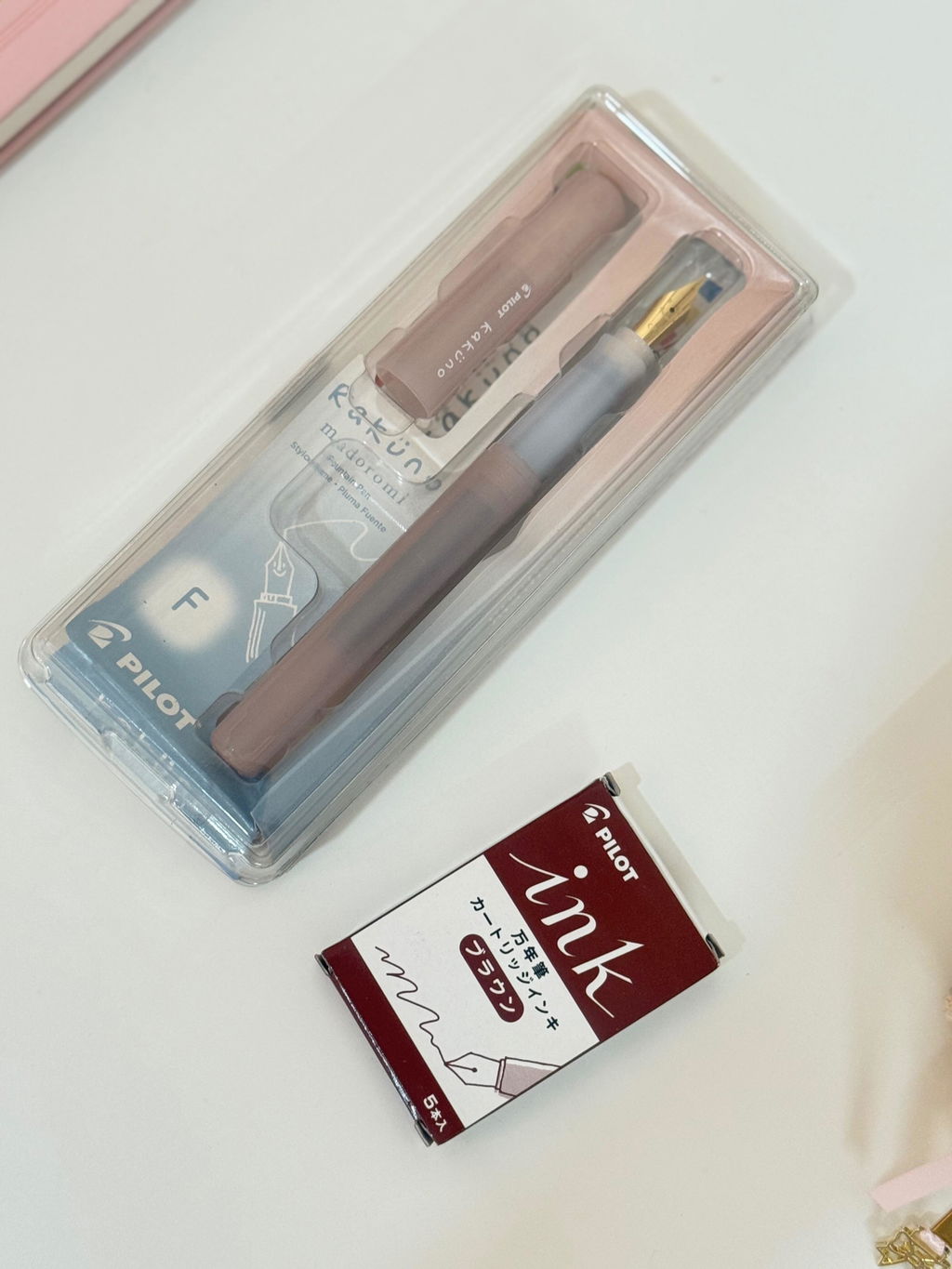
The Pilot Kakuno provides a visible nib cue and a lightweight body. It can be useful to consider, but should still be held and tested naturally. A feature designed to help beginners is not a requirement to position every finger identically.
If you prefer a different body, explain what feels wrong about the first one. A narrow section, a barrel step and an uncomfortable cap balance are separate issues. A clearer description leads to a better shortlist.

A five-minute test before choosing a pen
Write three normal lines, a short list and a few numbers. Do not slow down so much that the test no longer resembles your handwriting. Then repeat the same passage with another suitable nib or paper.
Notice three things: contact at the tip, where your palm moves and whether your grip tightens. Those observations separate nib discomfort from drying difficulty and body discomfort.
If testing several pens, keep the paper and ink as similar as practical. Otherwise, you may be comparing a wet formula with a dry one while attributing the difference to the body or brand.
Include ordinary pauses
Cap the pen, wait briefly and start a new note. This mirrors meetings and study sessions better than continuous loops. A setup needs to restart comfortably as well as write a long line.
Check that you understand the cap action and ink supply. A reliable routine is especially helpful when you are already paying attention to a new nib angle. Avoid introducing a complicated mechanism unless it is part of what you want to learn.
Build a setup for your main task
Study notes and small handwriting
Start with a comfortable body, a suitable finer line and an ink-and-paper pairing that dries in your normal rhythm. Keep the writing readable at the ruling size you actually use.
If your course uses photocopied sheets or prescribed stationery, test those materials. A notebook result cannot guarantee identical behaviour on an examination booklet or office form. Follow any specific writing requirements.
Journaling
You can choose the notebook, so use that freedom. Find a combination that feels pleasant over several pages and does not require you to hover awkwardly above the paper.
If you enjoy broader nibs or expressive colour, explore them deliberately. You may prefer a different setup for a slow journal session than for fast meeting notes. There is no need for one pen to satisfy every situation equally.
Creative lettering
Broad-edge and specialist nibs introduce their own angle requirements. Learn the intended tool and script rather than applying ordinary handwriting advice unchanged. Left-handed lettering is possible, but the setup should be considered specifically.
Our fountain pen versus calligraphy pen guide explains why different tools create different strokes. A specialist pen is useful when it matches the technique you want to practise.
What if the nib catches the paper?
First inspect pressure and rotation. Use light contact and keep the nib's writing face appropriately oriented. Try a suitable smooth sheet to separate rough paper from a pen problem.
If catching persists in particular directions, stop forcing it. Ask for an assessment rather than attempting to bend or polish the nib. A new user should not need to repair a writing tip to make it usable.
Our feedback and scratchiness guide helps describe the sensation. Ordinary feedback differs from snagging fibres or tearing the page.
What if the ink smudges even after waiting?
Some formulas can remain susceptible to surface transfer, particularly with concentrated effects or particular papers. A page that appears dry may still respond to moisture or friction.
Try another conventional ink or paper while keeping the pen constant. Record what changes. Avoid assuming you need a new body when the problem follows the ink-and-paper combination.
A clean spare sheet under your hand can help in some writing situations, but it should not conceal a setup that remains impractical for your main task. The goal is a routine you can use naturally.
Buying a fountain pen as a gift for a left-handed person
Ask about their existing pens and whether smudging is a frequent problem. A person who already writes comfortably with a conventional nib may not need a special LH option. Someone whose hand crosses every line may value drying behaviour more than decorative features.
Choose a suitable notebook and explain the ink supply. If possible, leave room for a model-specific conversation before settling on a specialist nib. The thoughtfulness lies in matching the recipient, not printing left-handed on the gift description.
Our first setup guide helps consider the complete combination. A pen alone does not determine whether the recipient's pages stay clean.
Keep a small comparison record
Use the same short paragraph for each test and write the pen, nib, ink and paper at the top. Add your normal hand position in plain words, such as hand beside the line. You do not need a technical classification to make the record useful.
After writing, note whether the difficulty was contact, smudging or comfort. For example, a page may remain clean while the section feels awkward, or the nib may glide comfortably while the last few words transfer to your palm. Those are different outcomes and should not be combined into one verdict that the pen is unsuitable.
Change one variable and repeat. If a new paper reduces smudging but creates feathering you dislike, the record shows the trade-off. You can then look for another balance rather than forgetting what improved and returning to the beginning of the search.
A realistic meeting-notes example
Imagine taking notes while looking up at a speaker frequently. You write a short phrase, pause and begin again. The pen needs to restart comfortably, the cap routine needs to feel manageable and the line needs to dry before your hand crosses it during the next entry.
Test that rhythm instead of writing one uninterrupted paragraph very slowly. A combination that works for a relaxed journal session may need adjusting for short, quick notes. You might keep the same pen and change ink or paper, rather than needing a separate instrument for every task.
Also consider where the notebook sits. A crowded table, thick binding or narrow margin can change your hand position. If a setup works at home but feels awkward in meetings, the writing surface may be part of the explanation.
Avoid turning every problem into a left-handed problem
An empty reservoir, poorly seated cartridge or dried feed can affect any writer. If the pen stops after a few lines, check the ordinary supply questions before attributing it to the direction of your strokes. Similarly, rough paper can make a fine nib feel uncomfortable in either hand.
This distinction is useful because it prevents unnecessary compromises. You should not have to accept a pen that repeatedly fails because someone assumes left-handed users must expect difficulty. Describe the symptoms and assess the instrument normally, then consider hand position where it actually changes the result.
Our first-use guide provides a baseline for normal operation. Once filling and supply are understood, the more individual choices about contact, drying and grip become easier to evaluate.
Our verdict: choose around your motion
Yes, left-handed writers can enjoy fountain pens. The useful path is to observe the hand, select a comfortable tip and body, and test ink and paper at a realistic pace. A special nib can be part of the answer, but it is not the whole answer.
At Makoba, tell us where your hand sits relative to the line, how small you write and what paper you use. If you already have a pen that works well, share that reference too. Those details help us recommend a setup around your writing rather than a general assumption about left-handedness.
Frequently asked questions
Will an LH nib prevent every smudge?
No. Hand movement, ink delivery and paper drying still matter. Consider the nib as part of a complete setup.
Must left-handed writers use Fine nibs?
No. Finer lines can be helpful in some situations, but contact comfort and handwriting size matter too. Test the actual combination.
Is a fountain pen suitable for fast notes?
It can be when grip, supply and drying suit your pace. Test with your normal writing speed rather than relying only on a slow demonstration.
What should I change first if writing is messy?
Identify whether the issue is smudging, feathering or nib contact. Then change one relevant variable. A clear diagnosis is more useful than buying another pen immediately.


Leave a comment