 Skip to content




Why Do Fisher Space Pens Actually Work Upside Down and in Zero Gravity — And Do You Need That for Everyday Writing?
There are some product claims that sound so good you instinctively become suspicious.
Writes upside down. Works in extreme temperatures. Writes underwater. Works in zero gravity.
Really?
For most of us, a pen has one fairly uncomplicated job: write when we ask it to. Yet the moment you hear about a Fisher Space Pen, suddenly you are thinking about astronauts floating around a spacecraft, scribbling notes while gravity politely steps aside.

And naturally, the next question is:
Do you actually need a pen that can write in zero gravity if your most dangerous daily mission is finding a working pen during a meeting?
Probably not.
But that doesn't make the Fisher Space Pen pointless.
In fact, the technology behind it solves a much more ordinary problem than space travel. To understand why these pens have developed such a loyal following, we need to look at a simple question:
Why does a normal ballpoint pen sometimes refuse to write?
And why does a Fisher Space Pen keep going when most pens would rather not?
First, Let's Clear Up the Biggest Myth: A Normal Pen Doesn't Need Gravity as Much as You Think
People often imagine that a regular pen works because gravity pulls ink down towards the ball.
That's not quite the full story.
In a conventional ballpoint pen, the ink sits inside a refill and is transferred to the rotating ball at the tip. Ink flow depends on several factors, including the ink formulation, the movement of the ball and the orientation of the pen.
Gravity can certainly affect how ink behaves in some writing instruments, particularly when ink flow relies heavily on liquid moving through a reservoir.
But a Fisher Space Pen takes a different approach.
Instead of simply relying on gravity and an open ink reservoir, Fisher's famous pressurised refill is designed to push the ink towards the writing tip.
That's the clever bit.
The pen doesn't sit around hoping the ink will eventually make its way to the ball.
It actively helps the ink get there.
The Secret Is the Pressurised Ink Cartridge
The heart of the Fisher Space Pen is its pressurised cartridge, commonly known as the Fisher Space Pen PR4 refill in many models.
Inside the refill, the ink is held under pressure using compressed gas. This pressure helps push the specially formulated ink towards the ball.
That means the pen can continue writing in positions where a conventional pen might struggle.
Upside down?
No problem.
At an unusual angle?
Still fine.
In zero gravity?
That was the whole point.

The technology was developed for environments where relying on the normal behaviour of ink simply wasn't good enough.
But before we get carried away imagining that every office worker needs astronaut equipment, let's appreciate something important.
The same technology that helps in space can be genuinely useful on Earth.
More on that in a moment.
Why Does a Fisher Space Pen Work Upside Down?
Try writing with an ordinary pen upside down.
Sometimes it works for a while. Sometimes it doesn't. Sometimes it starts perfectly and then decides it has had enough of your nonsense.
The issue is ink delivery.
A conventional refill may not be able to maintain consistent ink at the writing point when held in an unusual orientation.
A Fisher Space Pen refill, however, uses internal pressure to push ink towards the tip.
So whether the pen is pointing down, sideways or upward, the refill is still working to keep ink available at the ball.
It's a remarkably elegant solution.
And it answers one of the most commonly searched questions about these pens:
Yes, a Fisher Space Pen can genuinely write upside down because of its pressurised ink cartridge.
That isn't marketing poetry.
It's physics and engineering.
But What About Zero Gravity? Does It Really Work in Space?
Yes, and this is where the story becomes genuinely fascinating.
In zero gravity, liquids don't behave the way we're used to on Earth. You can't simply assume that ink will remain conveniently positioned at the bottom of a pen refill.
That creates an obvious problem if you're trying to write.
A pressurised ink system solves much of that problem by removing the need to rely on gravity to move ink towards the writing tip.
The Fisher Space Pen became famously associated with NASA and space missions because its technology was suited to the unusual demands of spaceflight.
But here's the important thing:
A pen doesn't become a good everyday pen just because it can survive space.
The real question is whether all that engineering makes a difference when you're sitting at a desk in Chennai, Mumbai, London or New York.
And surprisingly, sometimes it does.
The Real Everyday Advantage Isn't Zero Gravity
Let's be honest.
Most of us will never write a shopping list while floating through the International Space Station.
The average Tuesday doesn't require writing upside down from a spacecraft ceiling.
So why would anyone choose a Fisher Space Pen?
Because everyday life has its own annoying little versions of zero gravity.
Think about it.
Have you ever tried to write while standing?
Ever filled out a form with the paper resting against a wall?
Written inside a car?
Taken notes outdoors?
Needed a pen after leaving it in a bag for weeks?
Tried to write on a surface where you couldn't comfortably hold the pen at the perfect angle?
These are the moments when a reliable pressurised ballpoint pen starts making sense.
You may never need the "space" part.
But you may appreciate the reliability.
At Makoba, we believe that the best writing instrument is not always the one with the longest list of features. Sometimes it is simply the one that works exactly when you need it.
And Fisher Space Pens have built their reputation around that idea.
The Ink Is Different Too — And That's a Big Part of the Story
The pressurised cartridge is only half the equation.
The ink itself also matters.
Fisher Space Pen ink is formulated differently from the thin, free-flowing ink you might find in other writing instruments. The thicker formulation is designed to remain controlled inside the pressurised refill and deliver ink consistently to the writing ball.
That thicker, specialised ink helps explain why the pen is known for working in demanding conditions.
It also contributes to another advantage:
The ink isn't constantly sitting around trying to escape.
For people who carry pens in pockets, bags or travel kits, that matters.
A dependable refill is not glamorous.
Until your favourite shirt has an ink stain.
Then suddenly, refill engineering becomes extremely interesting.
Can a Fisher Space Pen Write Underwater?
This is another famous claim, and yes, the technology is designed to function in conditions where an ordinary pen would struggle.
However, let's pause for a moment and ask the practical question.
How often are you planning to write underwater?
If your answer is "regularly," you have a much more interesting lifestyle than most of us.
For everyone else, this feature is best understood as evidence of how controlled the ink delivery system is. The pen is engineered to operate beyond the conditions expected of a conventional ballpoint.
You don't buy it because you plan to write underwater.
You buy it because you like the idea that a little rain, a strange writing angle or an unpredictable environment isn't going to stop your pen from working.
Fisher Space Pen vs Fountain Pen: Completely Different Philosophies
At Makoba, we love fountain pens.
But comparing a Fisher Space Pen with a fountain pen is a little like comparing a Swiss Army knife with a chef's knife.
Both are useful.
Both can be beautifully made.
But they are designed for different moments.
A fountain pen is about the writing experience. The nib, the ink, the paper and the feeling of the pen moving across the page are all part of the pleasure.
A Fisher Space Pen is about reliability and portability.
One says:
"Let's slow down and enjoy writing."
The other says:
"We're leaving in thirty seconds. Put me in your pocket."
Neither is better.
They simply belong to different moods.
And honestly, many stationery enthusiasts own both.
There are days for a beautiful fountain pen and a bottle of ink.
There are days when you need a pen that has been sitting in your backpack for three weeks and will write immediately on a boarding pass.
That is where the Fisher Space Pen earns its place.
Does a Fisher Space Pen Feel Good to Write With?
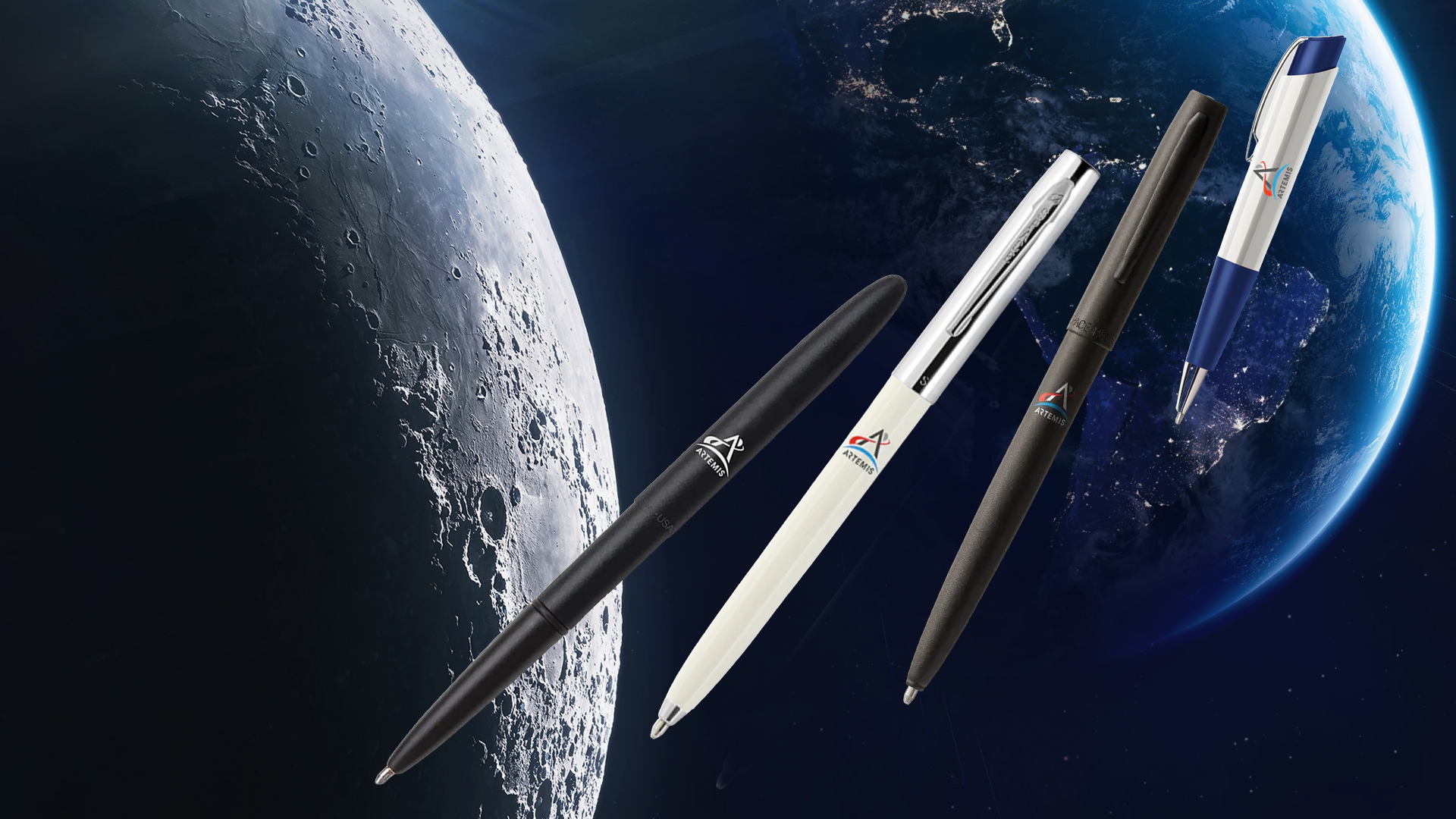
This depends on your expectations.
If you are used to the buttery glide of a well-tuned fountain pen, a Space Pen will feel different. Ballpoint ink and fountain pen ink are fundamentally different systems.
The writing sensation is more controlled and deliberate.
Some people love that.
Others prefer the effortless flow of liquid ink.
The design of the particular pen also plays a role. Fisher Space Pens are available in different shapes and sizes, from compact models designed for portability to more substantial pens intended for comfortable everyday use.
If writing comfort is your biggest priority, it's worth thinking about how you actually hold and use your pen, rather than buying based purely on the space story.
A pen can have the most impressive engineering in the world and still be the wrong shape for your hand.
So, Do You Really Need a Pen That Works Upside Down?
No.
Let's be completely honest.
You don't need one.
You also don't need a mechanical watch when your phone tells the time. You don't need a fountain pen when a ₹10 ballpoint can write a shopping list.
But writing instruments aren't always purchased because of necessity.
We buy them because we enjoy good design.
Because we appreciate engineering.
Because we like carrying something dependable.
And sometimes because it's genuinely reassuring to know that the pen in your pocket is probably more prepared for an emergency than you are.
That's part of the fun.
Who Should Actually Buy a Fisher Space Pen?
A Fisher Space Pen makes particular sense for people who value portability and reliability.
Frequent travellers
Compact pens are easy to carry, and dependable ink performance is useful when you're filling out forms, making notes or writing while on the move.
Professionals who work outdoors
If your work takes you outside rather than behind a desk, your writing conditions aren't always ideal.
Engineers, technicians and field workers
Sometimes you need to write while standing, leaning against something or working in awkward positions.
Everyday carry enthusiasts
If you like keeping a compact, dependable set of tools with you, a Space Pen is an obvious candidate.
People who simply hate unreliable pens
This might be the largest group of all.
Nothing is more annoying than reaching for a pen at exactly the moment you need it and discovering that it has decided to become decorative.
The Fisher Space Pen Is Also a Lesson in Good Product Design
What makes the Space Pen interesting isn't just the technology.
It's the focus.
The engineers identified a problem: conventional ink systems have limitations in extreme environments.
They developed a solution.
Then that solution became useful in ordinary life too.
That's often how great design works.
A feature developed for an extreme situation can eventually become valuable for a much more ordinary one.
Your smartphone probably has technology that once seemed extraordinary.
Your car contains engineering most of us never think about.
And your little pen?
It may contain a pressurised system designed to help it write when gravity isn't available.
That's a lot of engineering for something you might use to sign for a courier package.
But that's also rather wonderful.
Choosing the Right Writing Instrument for the Moment
There is no single "best pen."
The best pen depends on what you're doing.
If you want to enjoy a slow evening of journaling, choose a fountain pen and a beautiful notebook. Pair it with some of your favourite fountain pen friendly notebooks and organisers and enjoy the experience.
If you want to experiment with colours, shading and different writing personalities, explore a world of fountain pen inks.
But if you're heading out and want something compact, durable and ready to write whenever inspiration — or bureaucracy — strikes, a Fisher Space Pen has a very different appeal.
That is the beauty of stationery.
You don't have to choose one philosophy forever.
Our Verdict: Is a Fisher Space Pen Worth It for Everyday Writing?
Yes — but probably not for the reason you think.
You don't buy a Fisher Space Pen because you expect to write in zero gravity.
You buy it because the same engineering that makes it capable of writing in extreme conditions can make it remarkably dependable in ordinary ones.
The ability to write upside down is impressive.
Writing in zero gravity is iconic.
But the everyday benefit is simpler:
You take the pen out. You write. It works.
No shaking.
No scribbling circles.
No holding it tip-down for five minutes and hoping for the best.
For people who value reliability, that is a genuinely useful luxury.
At Makoba, we believe great writing instruments are not just about putting ink on paper. They are about finding the right tool for the moment.
A fountain pen can turn writing into a ritual.
A beautiful notebook can make you want to fill another page.
A favourite ink can give your handwriting personality.
And a Fisher Space Pen?
It can sit quietly in your pocket, waiting for the moment when you need a pen that simply refuses to care which way is up.
Do you need space-age technology to write your grocery list?
Of course not.
But knowing that your pen could probably write that grocery list while floating through space?
Well, that's just a rather brilliant bonus


Leave a comment